











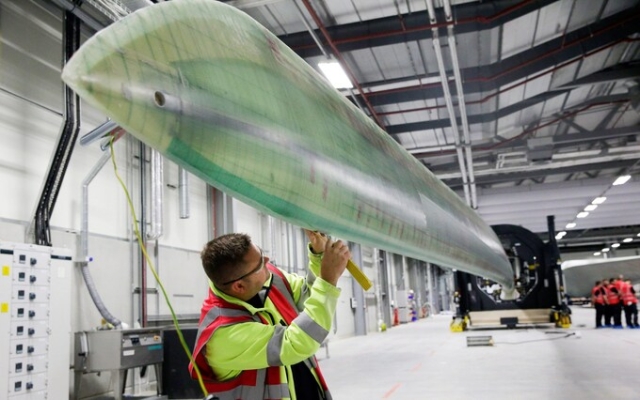
 Wrinkled rotor blades and faulty gears are among the manufacturing defects found. Photo: Matthew Lloyd/Bloomberg
When Siemens announced that in 2017, Siemens management entered into a deal to merge its wind energy business with competitor Gamesa.
Siemens CEO Joe Kaeser then stated that there was a “clear and compelling industrial logic» that will make «renewables more costly». -efficiently.»
However, the turbine industry has proven to be as fickle as the wind.
Siemens warned on Monday that it will suffer losses of 4.5 billion euros this year (3.9 billion pounds sterling). due to problems in the wind turbine division.
Wrinkled rotor blades and faulty gears are among the problems found that have resulted in performance issues and warranty claims from customers. Inflation has only added to the headache.
Acknowledgement of failure sent Siemens down €6bn on Monday.
The German industrial powerhouse has been in the wind power market for almost two decades, and Gamesa, which until last year was a joint venture with a history in the industry since the 1970s.
However, the rapid expansion of production in recent years has led to an over-expansion of the combined business.
Jochen Eickholt, Chief Executive Officer of Siemens Gamesa, admitted: «We sold the turbines too quickly», calling the company «a victim of our own ambitions ”.
Siemens Gamesa manufactures blades for wind turbines, which can be over 100 m long and consist of many layers of material.
The technology must be highly accurate and test for detected defects that cause «abnormal vibrations» that can lead to damage and other problems.
1705 Electricity generated from wind, solar and water power
Jochen Eickholt, CEO of Siemens Gamesa, attributed the problems to «wrinkles» within the layers of the blades and blamed the suppliers. Some of them were turned off in response.
The hiccups didn't occur before because the company was focused on quickly introducing new turbines and ramping up capacity, said Siemens Energy chief executive Christian Bruch.< /p>
Catherine Porter, an independent analyst at energy consultancy Watt Logic, said: “Developers have been putting pressure on bigger turbines because they are obviously easier to build then, but there were a lot of warranty issues.
«Now people behind the scenes are saying that maybe we need to take a break from these bigger and bigger turbines because they just keep breaking down.»
The profitability of the industry is long time was low. time, she said.
Problems in Siemens' turbine business are not new. In June, the company said it would cost €1bn to fix the problems, with Bruch calling the problems «more serious than I thought.»
The problems were focused on its onshore wind turbine business, which is a tougher market, than offshore.
However, worrisomely, new problems are still being discovered.
Deutsche Bank analyst Gael deBray said in a note: “As we feared, in addition to quality problems onshore, [Siemens Energy] expects higher production costs and further problems in the process of increasing capacity offshore, which has led to additional costs of 600 million euros.»
The German company is not alone in the struggle: its competitors and its customers are also grappling with the more expensive clean energy landscape.
 Energy giant Vattenfall last month shelved plans to build a massive wind farm off the coast of Norfolk. Photo: Vattenfall
Vestas, the world's largest wind turbine manufacturer, lost 1.5 billion euros last year due to soaring costs, especially metal prices.
CEO Henrik Andersen said in May: “The wind industry continues to face political uncertainty, slow permitting processes and high inflation, which we expect to continue into 2023.”
Operators also face serious challenges. Energy giant Vattenfall last month shelved plans to build a massive wind farm off the coast of Norfolk after soaring inflation made the project unviable.
Wind farms in the UK are largely governed by contracts for differences (CfDs), which are government deals that guarantee operators a stable price for their electricity for 15 years. This price stability helps developers borrow the money they need to build them.
However, the combination of rising costs and fixed profits far into the future means budgets can easily inflate.
Sweden's Vattenfall said, that her spending has risen 40% since her Whitehall deal last year. The surge has made a project that could power 1.5 million homes unviable.
Ana Musat, chief policy officer of industry group RenewableUK, said: “The economic circumstances are quite challenging across the board, we are seeing very high inflation, we are seeing interest rates rise. And if you work in a capital-intensive industry like this, it will immediately affect you.”
In CfD auctions, companies put forward a «strike price» at which they will sell electricity, and the most competitive bids result in subsidy deals with the government. When market power prices fall below this strike price, the company's revenues increase, and when it rises above, they make payments to the government. CFDs are funded by consumer account fees.
0907 Net Zero
The UK is currently in the middle of another contract bidding round. In this current round of distribution, which will end next month, offshore wind is competing against solar and onshore wind, which are cheaper to build.
The maximum strike price for offshore wind is set at £44 per megawatt. hour for this round called AR5, the price is very similar to the price of the last round ended last summer called AR4.
Duncan Clark, head of Ørsted in the UK and Ireland building the Hornsea 3 wind farm off the Yorkshire coast, said the current wind farm deals were a «great benefit» for taxpayers, but warned the company was hit by an «extraordinary combination» of higher costs. since then.
Musat said: “We have inflation at 11%, interest rates have risen by 5%. So I think that simply expecting projects to be able to realize the same cost profiles is not really realistic. Something has to go wrong.”
All this means that the wind industry is facing more, not fewer, stumbling blocks.
Siemens Energy has delivered its entire wind division, Siemens Gamesa , under control. review despite only recently taking full control.
The review will look at «all options,» Bruch said when asked if parts could be sold. An update is expected in November.
However, as problems escalate, Bruh remains optimistic. “We believe more than ever in the potential of wind energy,” he told reporters.
Investors hope this is more than empty talk.






















Свежие комментарии