


























To do this, the artificial intelligence needed to be trained on hundreds of photographs
Specialists from the Perm National Research Polytechnic University are developing a method for finding different types of microplastics in any material in a matter of minutes. They are helped in this by artificial intelligence.
 Photo: unsplash.com
According to data for 2022, plastic waste makes up about 1/9 of all garbage — 5 million tons per year. 46 million tons. And only 14–18% of its total amount is recycled.
What goes to landfill ends up in the natural environment. The decomposition period of plastic materials is hundreds of years. During this time, under the influence of many natural factors, for example, direct ultraviolet radiation, they disintegrate into microparticles less than 5 millimeters in size and are embedded in the environment. Microplastics are found almost everywhere: in water, soil and some types of food, such as marine fish and plants.
Scientists are looking for solutions to protect the environment from microplastics. And at first they need to find ways to quickly find it in soil, water and air. Until recently, the process of identifying microplastics in sand and soil was very labor-intensive and took a lot of time: the plastic was filtered out, looked through a microscope, subjected to spectral analysis and studied by many other physical and chemical methods.
At the Perm Polytechnic University they decided on an order of magnitude speed up this process by teaching it to a neural network. Specialists from the Department of Environmental Protection have developed a technology for identifying microplastics in sand using machine vision and artificial intelligence.
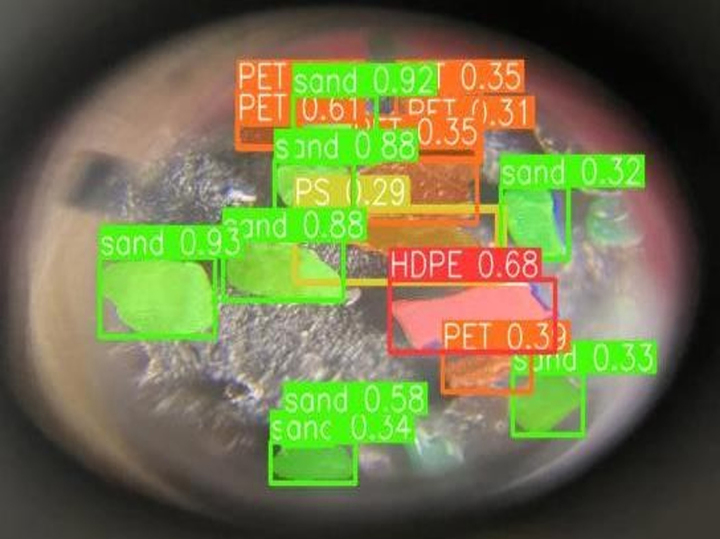 The result of the neural network to determine microplastics in sand. The numbers indicate the percentage of correct identification of particles of a particular substance in a mixture. Photo: Kirill Aristov
The most time was spent training the neural network to identify different types of microplastics: polyethylene terephthalate, polypropylene, low-density polyethylene. Each species was pre-washed, crushed and sifted through a sieve with a mesh size of 1 mm. Then these particles were mixed with ordinary sand.
The second stage of work is associated with training the neural network. She was offered a sample of one hundred images of sand with microplastics at 40x magnification.
The average accuracy of recognizing microplastics was 82.63%, which is considered a very good result.















Свежие комментарии