


















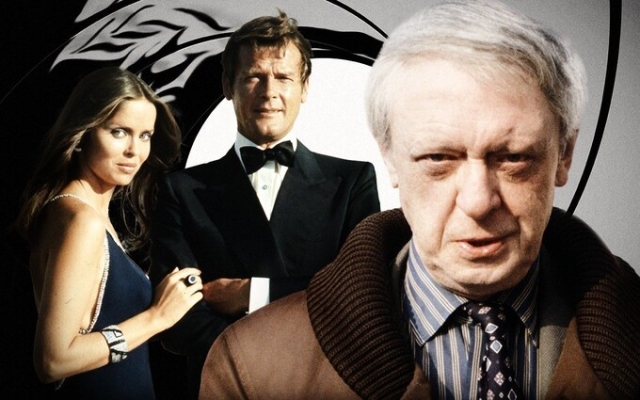
 Barbara Bach and Roger Moore in The Spy Who Loved Me — not written by Anthony Burgess (right)
It's now been over two years since Daniel Craig took his final bow as James Bond in No Time to Die, and there's still no sign of what the future holds for the film series. In November, 007 producer Barbara Broccoli revealed that she and her team hadn't even begun to think about how to reinvent the franchise for the next chapter, noting that the films have always reflected the times in which they find themselves. anarchic as it is today, what would that look like?
Perhaps the answer lies in the past, namely in one of the wildest pieces of Bond literature ever written — one that somehow involves Henry Kissinger, the Queen and the explosive appearance of the Archbishop of Canterbury. In early 1975, Anthony Burgess was on a lecture tour in New York when he was approached outside his hotel by producer Cubby Broccoli (Barbara's father) and Guy Hamilton, who had directed four Bond films, the last of which was The Man with the Golden Gun. .
They handed Burgess «a sheaf of paper and a portable typewriter» and asked him to write a «totally original script» for the next film in the series, The Spy Who Loved Me. The emphasis on originality was because Ian Fleming stipulated that only the title could be used from his novel of the same name, a modest gangster story set in an upstate New York motel that was critically panned upon publication.
< p>The author of A Clockwork Orange and The Malaya Trilogy may not have seemed the obvious choice for the task, but Burgess was a big fan of Fleming's work and in 1966 wrote Tremor of Intent, a spy thriller with elements of a Bond impersonation. The script he created for The Spy Who Loved Me has become a minor myth among Bond buffs because details about it are both sparse and outlandish: a terrorist plot to blow up the Queen at the Sydney Opera House, the Pope forced to whitewash the Sistine Chapel, a cameo from Henry Kissinger, miniature nuclear devices implanted in people.
Burgess gave a summary of this in the second volume of his memoirs, You Had Time, but the actual material never materialized. In 1988, Burgess's Monaco apartment was flooded, partially destroying his collection of manuscripts, and among those he listed on his insurance claim as «destroyed by water» was a 150-page script for The Spy Who Loved Me.
But, amazingly, some of the material he wrote for the film has survived and has been in the Harry Ransom Center library at the University of Texas since the 1990s, along with 138 other boxes of Burgess's manuscripts, correspondence and other items. — all purchased from the author's widow and former agent Liana Burgess. I discovered this in 2020 by simply Googling «townie» «the spy who loved me»; The result was an inventory of the library.
I excitedly filled out the form requesting access to this box of materials. They never responded and I completely forgot about it. Then a couple weeks ago a friend said something that reminded me of this and I emailed him again to ask if they had seen my original request. The archivist apologized and sent me a PDF file 10 minutes later. It was a 44-page outline of the entire film, undated and marked «first draft», containing everything Burgess claimed was in it and more.
This is a fascinating read. Burgess's approach was less ultraviolent than ultraabsurd, although there are echoes of the chilling nihilism of A Clockwork Orange. Instead of SMERSH or SPECTER, Burgess created a new villainous group — the Consortium to Accelerate the Destruction of Organized Society, or CHAOS. The brief description begins with the organization's head, Schnitzler, welcoming participants to the group's eighth annual plenary conference.
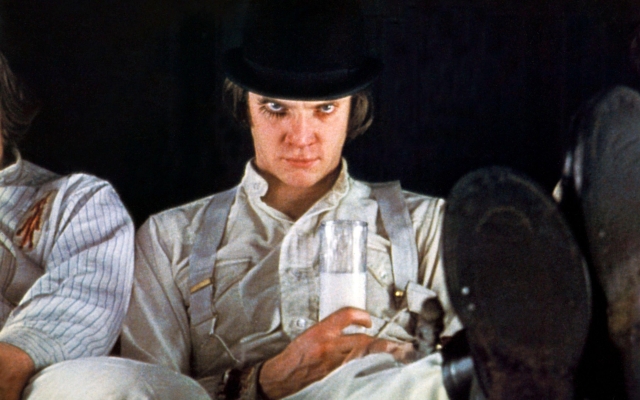 Malcolm McDowell in the film “A Clockwork Orange” Photo: Alamy
He announces that their dividend will unfortunately be lower this year due to inflation and the recession, takes a sip of milk and dies. His poisoner Feratu immediately becomes the new head of CHAOS, declaring that he has eliminated the «smell of defeatism» and that the dividends will not be reduced. The doors swing open and a newcomer enters: Teodorescu, «rough, menacing» in a wheelchair, long thought dead by the others. He is accompanied by his beautiful daughter Elaine, whose left side of her face is covered with a red spot. She shoots Ferat between the eyes, and her father becomes the third head of CHAOS. All this is on the first page of the structure.
Teodorescu has a different attitude towards his very recent predecessors. As Elaine burns five million dollars worth of bills in the conference room fireplace, he explains that money doesn't matter and that under his leadership, the group will return to its original goals and finally achieve a «global takeover.» His plan is to destroy civilization for fun: wanton terror on a large scale. The camera lingers on the drawing above the fireplace: “an image of a destroyed world called CHAOS.”
In just a couple of pages, Burgess has laid out the Bond idea like no other, but with each scene the scheme becomes even more outrageous. CHAOS blackmails the Pope into whitewashing Michelangelo's Sistine Chapel frescoes (the British ambassador's daughter will be killed if he doesn't), extorts money from several world leaders, forces Henry Kissinger to perform what is implied to be a sex act, and blows up a plane carrying the Archbishop Canterbury moments after he put on his headphones to watch The Spy Who Loved Me in-flight.
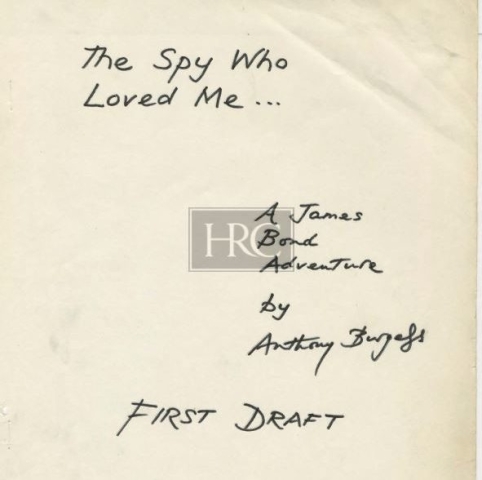 Cover of Anthony Burgess's sketch for The Spy Who Loved Me. Photo: Harry Ransom Center
The world is in panic and only one person can stop the threat. James Bond himself is portrayed in a fairly traditional way, wearing black tie, shooting an arrow in a fight scene in Singapore, and making cool jokes about food and wine under pressure. However, although some scenes seem tailor-made for Roger Moore, there are indications that he may not have had this in mind. In the scene in which M congratulates Bond on completing his 50th successful mission, he rejects a cigarette case made by Q from the bullets of his enemies: “I smoke cigars now, gentlemen. You are confusing me with my predecessor, who had the same number. And yet – I am grateful.” It's not too far off from the idea in No Time to Die, in which a new agent takes over the 007 mantle from Bond.
Teodorescu, who was also a character in Burgess's 1966 novel A Tremor of Intent, fits much of the classic mold of a Bond villain. Working on a tanker in the Pacific, he instructed his agents at a clinic in Bavaria to secretly insert miniature nuclear devices into patients during operations, hoping to then remotely activate this «living arsenal.» They also find recruits from those contemplating suicide. This work is led by Fleming, a thin, ascetic Scottish doctor. Having a character named after Bond's creator, a sanctimonious villain, is a very nice touch.
To justify the film's title, Burgess asks Elaine Theodorescu to try to kill Bond by locking him over a furnace in a Bavarian dungeon, only for him to escape and the two to fall in love. They are even planning to get married. It turns out that she was rejected in an affair with another British agent, Tony Graham, 005, and the experience left her psychosomatically disfigured.
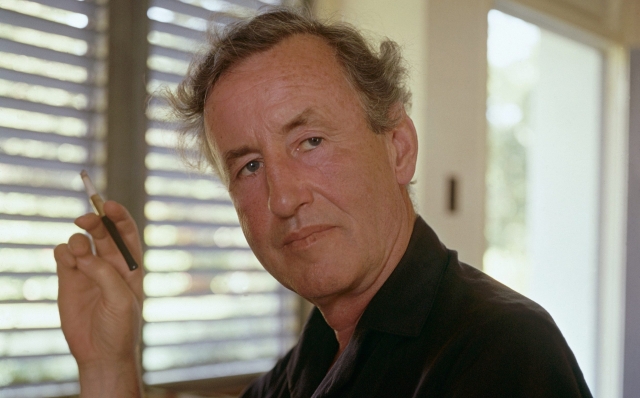 Ian Fleming in 1962 Photo: Getty
The rival love interest is beautiful opera singer Jean Northumberland, who helps Bond when he is ambushed by CHAOS agents in a hotel room in Rome, using the power of her piercing high notes to shatter a light bulb in the ceiling. However, she is unaware that CHAOS has already implanted nuclear weapons in her and plans to use her to kill the Queen when she is presented to her at the upcoming performance of Salome at the Sydney Opera House.
Bond quickly operates on Jean's stomach using acupuncture needles and a pocketknife, removing the miniature nuclear bomb. But in the TV crew's van watching an opera nearby, Dr. Fleming reveals that he placed several nuclear devices inside Teodorescu during a routine gall bladder operation, making it a backup weapon to kill the queen. Bond snatches a motorcycle from a passerby and chases Fleming and the others through the streets of Sydney. Catching up with them, Teodorescu bursts through the van's doors and his wheelchair turns into a hovercraft. However, the bomb inside him is activated and he explodes over Sydney Harbour.

After surviving the shootout, Fleming tracks down Bond and Elaine and reveals that he plans to reform CHAOS under the name of the New Association of Saints, the Beginning of the Age of Sexlessness and Sinlessness. Bond notes that it all comes down to N.A.S.T.I.N.E.S.S. (although the letter appears to be missing). “Man must be reborn,” Fleming tells Bond. “Man has become an abomination, a stinking beast.” Bond responds by setting a boxing kangaroo on him.
The plot ends with the Bavarian clinic rising in a mushroom cloud thanks to Jean's voice activating the correct frequency and the disappearance of the scar on Elaine's face. Both women agree that they cannot keep Bond alive, so he flies off into the sunset. Burgess saw it as the first Bond film to use an operatic title song, and even included a snippet of lyrics to it: «He flew away/He flew away/The spy who loved me/I, I alone.» A note in the text indicates that he also wrote the musical arrangement himself (Burgess was a prolific composer).
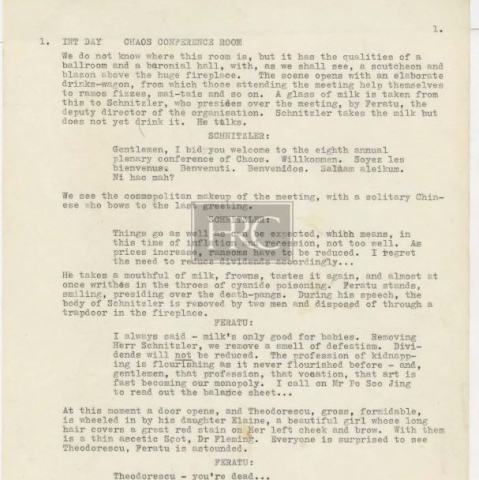 Excerpt from the mythical Burgess' script. Photo: Harry Ransom Center
Unsurprisingly, Bond producers rejected the material. Burgess wrote in You've Had Your Time that although he followed the formal pattern of the Bond films as closely as he could, «I knew from the start that it wouldn't work, but a terrible fascination kept me going.» Most of his ideas were too outrageous, subversive, or just plain gross to make it on screen (there's a scene in which Bond acupunctures Miss Moneypenny, with its attendant double entendres, and M tells him, «Now is not the time for fornication»).
Several screenwriters contributed to the film's development, including novelist Ronald Hardy, The Twilight Zone's Sterling Silliphant, and future Blues Brothers director John Landis. However, the tone and plot of the finished product — from a script attributed to Christopher Wood and Richard Maibaum — did not differ much from Burgess's plan. The villain Stromberg also operates on a huge tanker. Like Theodorescu, he wants to destroy civilization with nuclear weapons because he feels that humanity cannot be saved, and start over by taking responsibility for himself. A beautiful enemy agent seeks revenge for the death of her secret agent lover and ends up falling in love with Bond.
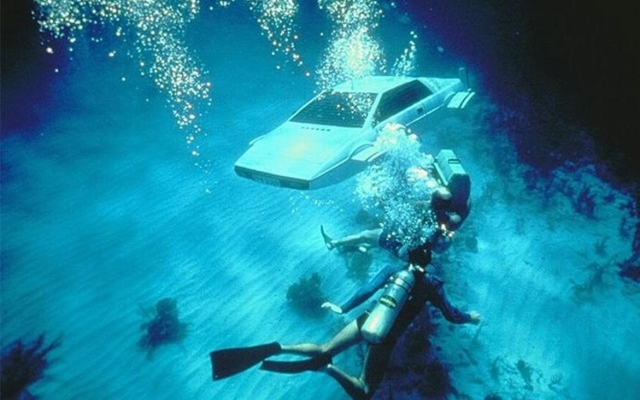 Scene from the film “The Spy Who Loved Me” Author: Pennsylvania
Wheelchairs don't transform into hovercrafts, and cars don't transform into submarines. Several later films in the series also contained ideas almost as outlandish as those described in this review, such as Bond's visit to outer space, and some seem to contain echoes of this: For Your Eyes Only opens with a sequence in which the wheelchair-bound Blofeld Figure attempts to crash Bond's helicopter using remote control but is killed, while in Moonraker the gondola becomes a hovercraft. CHAOS's implantation of miniature weapons into people to blow up passenger planes foreshadows both Al Qaeda's use of suicide bombers and No Time to Die's programmable nanobot weapons.
Burgess's plot is a strange piece of cinematic history, but it is also exciting reading; even in its cursory confines becomes both tense and strangely poignant. Even at 44 pages, it feels like the plot of a full-fledged Bond film, with plenty of real ideas to mull over amidst the savage satire. The idea of destroying the world for the sake of thrills is frightening and could have evoked a genuine sense of horror if it had been played straight. Bond's producers could do worse than rummage through this material for ideas on where to go next, be it characters, situations or the central idea of a terrorist group wreaking havoc for fun. Barbara Broccoli, if you're reading, perhaps Bond's future is, dare I say… CHAOTIC?
All quotes from Anthony Burgess' draft of The Spy Who Loved Me courtesy of Harry Ransom Center, Austin, Texas


















Свежие комментарии