
























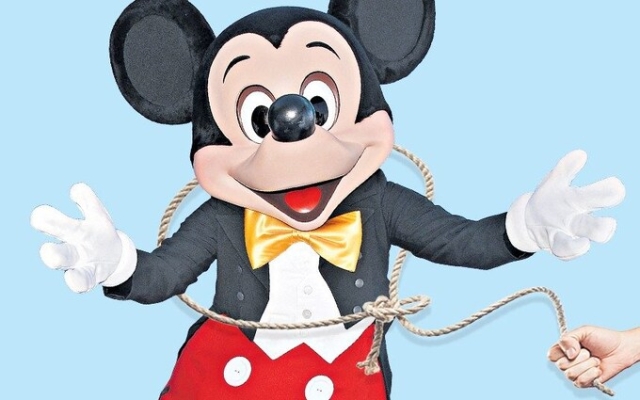

From the point of view of boxing matches, the fight between the American “Cable Cowboy” and the House of Mouse is certainly unusual.< /p>< p>In one corner stands John Malone's Charter Communications, one of the largest cable TV and broadband providers in the United States.
In the other is Bob Iger, the respected TV and film boss. Walt Disney.
The two media giants became embroiled in a dispute over money that resulted in Disney Channels being pulled away from Charter's television platform, Spectrum.
Due to a power outage, millions of people were unable to watch the US Open tennis tournament. Even player Daniil Medvedev said he was forced to watch an illegal broadcast.
At first glance, their breakup appears to be a classic “carriage dispute” over the royalties that Charter pays Disney to broadcast its channels.
But experts say the fight could have far-reaching consequences for Disney. the future of television in the era of streaming platforms such as Netflix.Most Charter customers first learned of the Disney scandal on Aug. 31, when the channels normally occupied by ESPN, ABC, National Geographic and other Disney brands suddenly disappeared from their set-top boxes.
In their place there was a message: “The Walt Disney Company, the owner of this channel, has removed its programs from the Spectrum.”

The dispute is preventing nearly 15 million households from watching not only tennis, but also college football and other major games such as Monday night college football broadcasts. This risks facing backlash against both companies.
“We've almost always avoided these kinds of controversies,” Christopher Winfrey, president of Charter Communications, said on a call with analysts and investors last week. “But we had to draw a line in the sand.
“We respect the product that Disney makes and its management team, but the video ecosystem is broken.”
Charter, which has 32 million customers in 41 states, says it has no choice but to close Disney Channels after lengthy and difficult negotiations with Disney over a new contract.
The company, which includes Liberty Media, Malone's main business as its main shareholder, says Disney is demanding more money for its channels but is refusing to give Charter customers access to its Disney streaming service.
Malone, a billionaire businessman nicknamed the industry's «Cable Cowboy,» has a right to be cautious.
The rise of streaming services has led to a surge in so-called «cord cutting,» in which U.S. households are canceling their expensive cable packages and opting for cheaper streaming services instead. The trend threatens the core of its business.
Charter says its customers are being charged twice for Disney programming: once as part of access through a cable package, and again if they want to stream it.
Disney also wanted to provide «even less flexibility» in bundling its channels, Charter said.
The company says it previously planned to pay Disney $2.2 billion for content in 2023, but the entertainment giant's latest demands «ignore the realities of today's video business.»
 John Malone's core business Liberty Media is the majority shareholder of Charter Communications. Photo: REUTERS/Rick Wilking
Over the past five years, the linear video (scheduled television) industry has lost nearly 25 million customers, or about 25% of the previous total.
«It's staggering,» she said. Winfrey.
>
That's largely the result of services like Netflix eroding the structural advantages that linear TV providers have enjoyed in the past, says Tom Harrington, head of television at Enders Analysis.
Overall In some parts of the US There are only one or two cable and broadband providers available, resulting in higher prices than in the UK and less choice.
It has always been common practice to bundle popular channels like Disney's ESPN with less popular ones.
But people are much less willing to pay for channels they won't watch in the era of «free-to-watch.» “la carte” streaming services that allow them to choose what and when to watch.
“For cable providers like Charter, the situation is as bad as it has ever been,” Harrington says.
Meanwhile, many traditional content producers that have long licensed channels and programming to cable services are themselves losing money as they compete with Netflix by launching their own streaming platforms.
Disney+ ; offers audiences everything from traditional animated classics like Cinderella and Beauty and the Beast to Marvel films, Star Wars spin-offs and TV series like Atlanta.
Themes however, Disney's streaming service lost $512 in the last quarter alone. m — total losses since launch in 2019 amounted to $11 billion.
Iger, who led the company from 2005 to 2020 before returning last year, has been brought back to get its finances in order. It couldn't hurt to squeeze a little more money out of partners like Charter.
Competing services including Paramount™, Warner Bros Discovery's MAX and NBCUniversal's Peacock are facing similar challenges.
Many want to attract subscribers to their new streaming platforms by offering a library of content they can't access elsewhere, while at the same time selling their content to cable providers.
In some cases, this has led to to attempts to circumvent exclusive agreements with cable television companies in ways that raise eyebrows.
For example, CNN news programs must be broadcast first on cable and satellite television. services he deals with.
However, the channel decided to produce exclusive programs for the HBO MAX service to circumvent these restrictions.

For Disney and its competitors, royalties from linear television remain a vital source of revenue, bringing in far more than streaming.
The Disney-Charter dispute should be viewed in this context, says Harrington.
“Cable TV companies are under stress. But Charter probably believes that Disney is under pressure too, and has calculated that they can go a little further than if things were going well,» he explains.
«They also believe that the channels Disney is not worth it in the same way as during the last negotiations, because a lot of the content is now on Disney.»
Also hanging over the negotiations is Disney's refusal to guarantee that cable customers who already pay for the ESPN channel will be able to access ESPN's planned on-demand service without paying extra.
“They want to require customers to pay twice for content apps with linear video that they have already paid for,” said Charter's Winfrey.
The scandal has parallels with a separate controversy , set across the Atlantic, with traditional British twists.
This is where companies such as the BBC, ITV, Channel 4 and Channel 5 have been battling pay-TV providers and TV producers for years over so-called «displayability» or where their own apps and content are placed in the software's main menus.
For years the BBC has occupied prestigious channels such as 101 and 102 on set-top boxes such as Sky and Freeview, but there are currently no hard and fast rules on where TV manufacturers such as Samsung , should place them in the menu of smart TVs.
Instead, producers have struck deals that give companies like Netflix better rates, and even include «Netflix» buttons on their TV remotes.
0807 Viewing numbers are falling
This new broadcast land grab comes amid an economic crisis . a once-in-a-generation change in the way people view things.
Audiences are flocking to the Internet, especially young people. Public broadcasters are desperate to create the next of their own services, including BBC iPlayer, ITVX and Channel 4 On Demand, amid panic they could be left behind by Hollywood giants.
Ian Katz, chief content officer Channel 4 recently defended the steep decline in the channel's so-called linear audience, insisting it was instead prioritizing its streaming platform.
«Frankly, any broadcaster who is obsessed with linear ratings now risks going the way of Kodak or Blockbuster — great brands that don't see the ground being pulled out from under them,» he said at the Edinburgh TV Festival last month.< /p>< p>In the US, experts say Charter's big showdown with Disney could ultimately destroy the traditional pay-TV model.
Disney, for its part, says it has offered «the most favorable terms.» about tariffs, distribution, packaging, advertising and much more.” Negotiations are currently underway.
“Charter has refused to enter into a new agreement with us that reflects market conditions,” the company said.
“We are on the edge,” Winfrey said last week. “We either move forward with a new model of collaborative video, or we move on.”
With fists raised, the only question now is who will blink first.
“We are on the edge chasm,” Winfrey said last week. «We either move forward with a new shared video model or move on.»
In a new statement Thursday night, Disney accused Charter of «abandoning its consumers» but said it was «committed to resolving this dispute.» .
Disney accused Charter of rejecting «multiple offers to extend negotiations before shutting down Disney Entertainment networks» and said it had «offered creative ways to make its streaming services available.» to Charter's Spectrum TV subscribers.»
The media giant said: «The question for Charter is clear: Do you care about your subscribers and what they tell you they want — or not?»


























Свежие комментарии